
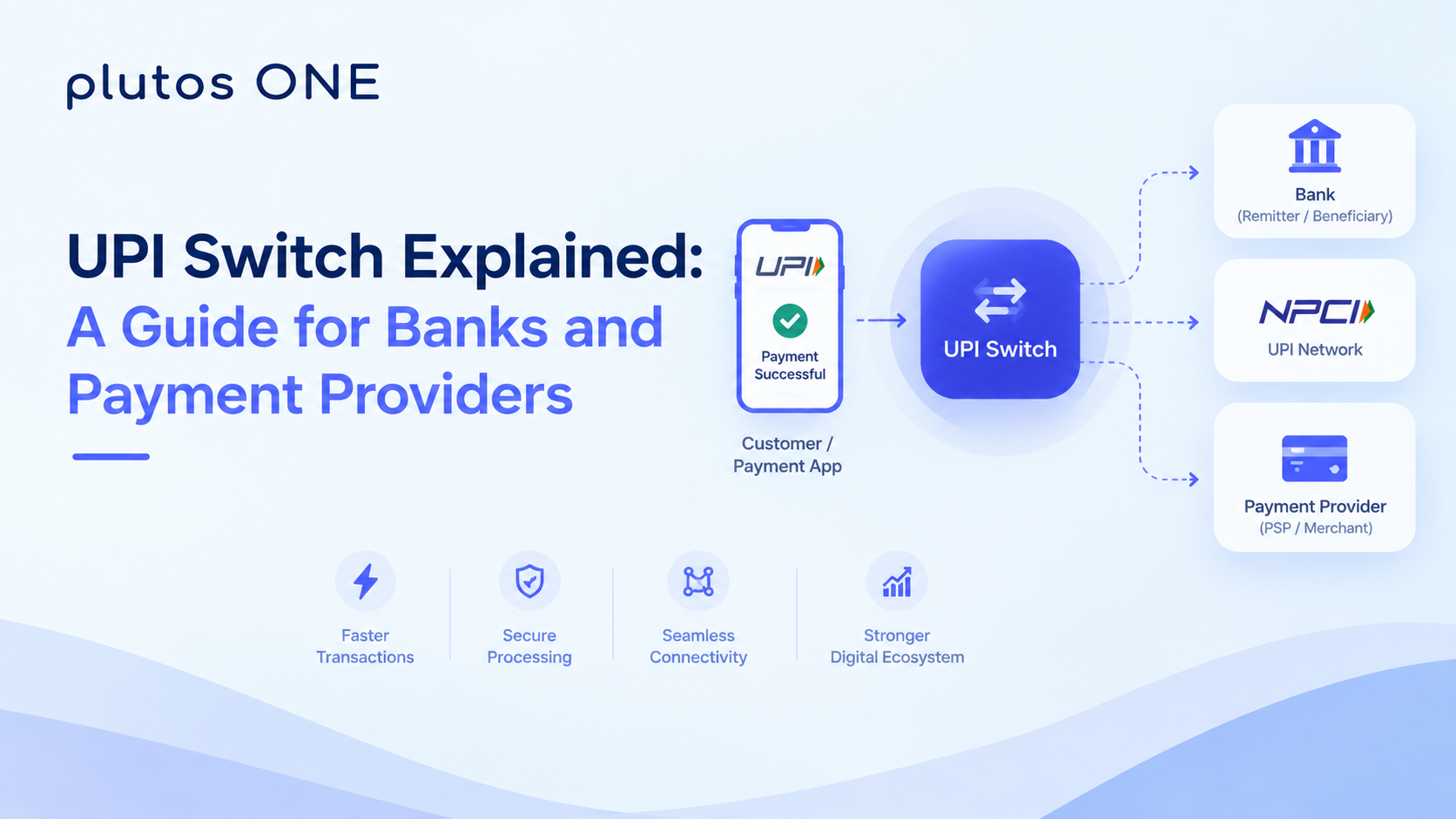
UPI has changed how people and businesses in India send and receive money. Behind these instant payment experiences is a network of systems that communicate to process transactions between participating banks and payment applications.
A UPI switch is an important part of the technical infrastructure involved in processing UPI transactions. For banks and payment service providers, understanding how this infrastructure works helps when planning integrations, managing transaction traffic, and improving payment operations.
In this guide, we explain what a UPI switch is, how it works, its key functions, and what banks should consider when evaluating a UPI switching solution.
What Is a UPI Switch?
A UPI switch is a technology system used to process and manage UPI transaction messages between a participant’s banking or payment systems and the UPI network.
It helps handle transaction requests, communicate with connected systems, and return responses to the relevant application or banking system. Its exact responsibilities depend on the participant’s role and how its payment infrastructure is designed.
It is important to distinguish a participant’s UPI switching system from the central UPI network. The National Payments Corporation of India (NPCI) operates the UPI network and coordinates the ecosystem, while participating banks and other authorised entities perform their respective functions.
How Does a UPI Switch Work?
The transaction flow varies depending on whether the payment is person-to-person, merchant-based, or handled through a particular participant’s infrastructure. A simplified payment flow generally involves these stages:
1. A customer initiates a payment
The customer starts a UPI transaction through a participating application, such as by entering a UPI ID or scanning a merchant QR code.
2. The payment request is submitted
The application and its connected payment systems pass the transaction request through the relevant participating entities. The request contains the information required to process the payment.
3. The transaction is routed through the UPI network
The relevant systems exchange transaction messages through the UPI ecosystem. The participating banks perform their assigned functions, including the required authentication and account processing.
4. The transaction is processed
The remitter bank handles the debit-side processing, while the beneficiary bank handles the credit-side processing, according to the transaction flow and applicable rules.
5. The transaction response is returned
The transaction status is communicated back through the connected systems to the relevant application. The customer receives a success, failure, or other applicable status.
A UPI switch supports the technical processing and communication required for these interactions. The switch alone does not guarantee that every payment will succeed, because the outcome can also depend on bank systems, network availability, authentication, and other factors.
What Are the Main Functions of a UPI Switch?
A UPI switching system can support several important payment operations, depending on its design and the participant’s requirements.
Transaction processing and message handling: Processes UPI-related transaction messages according to the applicable technical specifications.
System connectivity: Supports communication between the participant’s banking or payment applications and the relevant payment network.
Transaction status management: Helps systems process and communicate transaction responses so that payment statuses can be tracked.
Transaction monitoring: Provides operational visibility into transaction activity, errors, and system performance when the required monitoring capabilities are available.
Scalability and resilience: A well-designed system can be built to handle changing transaction volumes and recover from technical disruptions. Actual performance depends on the complete infrastructure and its configuration.
Security and compliance support: The implementation must support applicable security controls, technical standards, audits, and NPCI requirements relevant to the participant and its role.
These capabilities should be evaluated against the actual features offered by a provider rather than assumed to be available in every UPI switch.
Why Is a UPI Switch Important for Banks?
Banks need reliable infrastructure to process digital payments while maintaining connectivity with the wider UPI ecosystem. A suitable switching system can support this requirement in several ways.
-
Efficient transaction handling: Helps manage transaction messages and responses across connected systems.
-
Better operational visibility: Monitoring and logs can help technical teams investigate transaction issues.
-
Integration with existing systems: A suitable architecture can connect with a bank’s existing applications and infrastructure.
-
Capacity planning: Performance testing and scalable architecture help prepare for periods of higher transaction demand.
-
Simpler troubleshooting: Transaction-level information can help teams identify where processing issues occur.
-
Infrastructure readiness: A well-planned implementation can support future changes, subject to applicable technical and regulatory requirements.
However, a switch is only one part of the overall payment environment. Reliable UPI operations also depend on core banking systems, network connectivity, security controls, operational processes, and the requirements set by the relevant ecosystem participants.
UPI Switch vs Payment Switch: What's the Difference?
A payment switch is a broad term for technology that routes transaction messages between connected payment systems. A UPI switch refers more specifically to switching infrastructure used in the UPI environment.
A UPI switch is therefore a specialised part of the broader payment switching landscape.
Before selecting a UPI switch provider, banks should assess the following areas. 1. Integration requirements Check compatibility with existing banking systems, APIs, infrastructure, and the technical specifications applicable to the bank’s role. 2. Performance and capacity Review expected transaction volumes, latency requirements, load-testing results, and performance under peak conditions. 3. Availability and resilience Understand the architecture for redundancy, disaster recovery, fault handling, and service continuity. 4. Monitoring and troubleshooting Ask what transaction-level logs, operational dashboards, alerts, and reporting capabilities are included. 5. Security and compliance Validate the provider’s security controls, audit support, certification status where applicable, and alignment with relevant NPCI and regulatory requirements. 6. Implementation and ongoing support Evaluate implementation timelines, testing processes, incident management, documentation, and technical support arrangements. Banks should request technical documentation and evidence for important claims, including availability, performance, and compliance. A feature list alone is not enough to assess whether a solution fits their operating environment. UPI switching is one component of the broader digital payment infrastructure used by banks and financial institutions. Other components may include payment orchestration, transaction monitoring, reconciliation, and integrations with different payment networks or services. These systems have distinct responsibilities. For example, switching supports transaction processing and communication within a defined payment flow, while reconciliation helps compare transaction records across systems to identify mismatches and unresolved items. For banks evaluating payment infrastructure, the right architecture depends on their business objectives, existing technology, transaction requirements, and the capabilities they need from each component. Plutos ONE is a payments infrastructure fintech and an NPCI Technology Service Provider (TSP) for Bharat Connect. The company works with banks, fintechs, and enterprises to deliver solutions across Bharat Connect, including Bill Payments, Banking Connect, and Bharat Connect for Business. It also powers bank-led merchant-funded offers platforms and develops payment switching solutions across UPI, NETC, IMPS, and BBPS, supporting the growth of India’s digital payments ecosystem. Exploreplutos ONE to learn more about its payment infrastructure. No. UPI is the payment system operated by NPCI. A UPI switch is a technical system used for transaction processing and communication within a participant’s relevant infrastructure. Not necessarily. The required setup depends on the bank’s role in the UPI ecosystem, its existing infrastructure, and its participation and integration arrangements. No. It can support transaction processing, monitoring, and troubleshooting, but failures may also arise from connectivity issues, bank systems, authentication, network conditions, or other factors. A UPI switch supports transaction processing and message exchange within a defined payment flow. Reconciliation compares records from different systems to identify discrepancies, missing entries, or transactions that need further investigation. A bank should assess technical compatibility, performance, resilience, security, monitoring, implementation support, and compliance with the requirements applicable to its role in the UPI ecosystem.What Should Banks Consider When Choosing a UPI Switching Solution?
How Does UPI Switching Fit Into Payment Infrastructure?
Frequently Asked Questions
1. Is a UPI switch the same as UPI?
2. Does every bank need its own UPI switch?
3. Can a UPI switch prevent all transaction failures?
4. What is the difference between a UPI switch and payment reconciliation?
5. How should a bank evaluate a UPI switch provider?