
What is Banking Connect?
Banking Connect — officially referred to as IBMB (Internet Banking & Mobile Banking) — is an interoperable net banking infrastructure built by NPCI Bharat BillPay Limited (NBBL), a wholly owned subsidiary of NPCI. In simple terms, it's a standardized system that lets a bank connect once to a central switch and reach every merchant and payment aggregator on the network, instead of building and maintaining separate integrations with each one.
Before Banking Connect, net banking worked on a bilateral model: every bank had to individually integrate with every payment aggregator (PA) it wanted to work with, and every PA had to do the same with every bank. This created a tangled mesh of one-off integrations, each with its own technical specs, security protocols, and dispute-resolution process. NBBL's Managing Director and CEO, Noopur Chaturvedi, has described this legacy structure as a web of bilateral ties between merchants, aggregators, and banks — one where NBBL's role with Banking Connect is to absorb that complexity centrally rather than leave it scattered across the ecosystem.Banking Connect flips this on its head. One integration, one certification, one dispute-management framework — and interoperability across the entire network. It's essentially the same logic that made UPI successful, applied to net banking and mobile banking.
The platform was officially launched at the Global Fintech Fest (GFF) 2025 in the presence of RBI Governor Sanjay Malhotra, and the underlying regulatory approval for an interoperable internet banking system was granted by the RBI back in March 2024. It's a live, RBI-backed, NPCI-governed standard — not a private product from a single vendor.
Key characteristics of Banking Connect:
-
A single integration point for banks, payment aggregators, and merchants
-
Real-time settlement support to cut delays and counterparty risk
-
Centralized dispute management with faster, more transparent resolution
-
Mobile-first architecture built around how Indians actually bank today
-
No network-imposed transaction ceiling (individual banks can still set their own limits)
-
AI/ML-based monitoring to flag suspicious transactions before they settle
If you've already read our Bharat Connect (BBPS) guide, think of Banking Connect as BBPS's sibling platform — same parent (NBBL/NPCI), same "standardize once, scale everywhere" philosophy, but built for net banking and mobile banking payments rather than recurring bill payments.
Why Banking Connect is Transforming Digital Banking
India's digital banking story so far has been a story of fragmentation disguised as progress. UPI solved person-to-merchant payments beautifully. Cards got tokenized and secured. But net banking — still one of the highest-value payment rails for insurance premiums, large-ticket e-commerce, EMI payments, and B2B collections — never got the same standardization treatment. Every bank's net banking flow looked and behaved differently, onboarding a new payment aggregator could take 10 to 15 days per bank relationship, and reconciliation was a manual, bank-by-bank exercise.
Banking Connect is transforming this because it does for net banking what UPI did for peer-to-peer payments: it turns a fragmented, bilateral mess into a standardized, interoperable rail that any participant can plug into once and use everywhere.
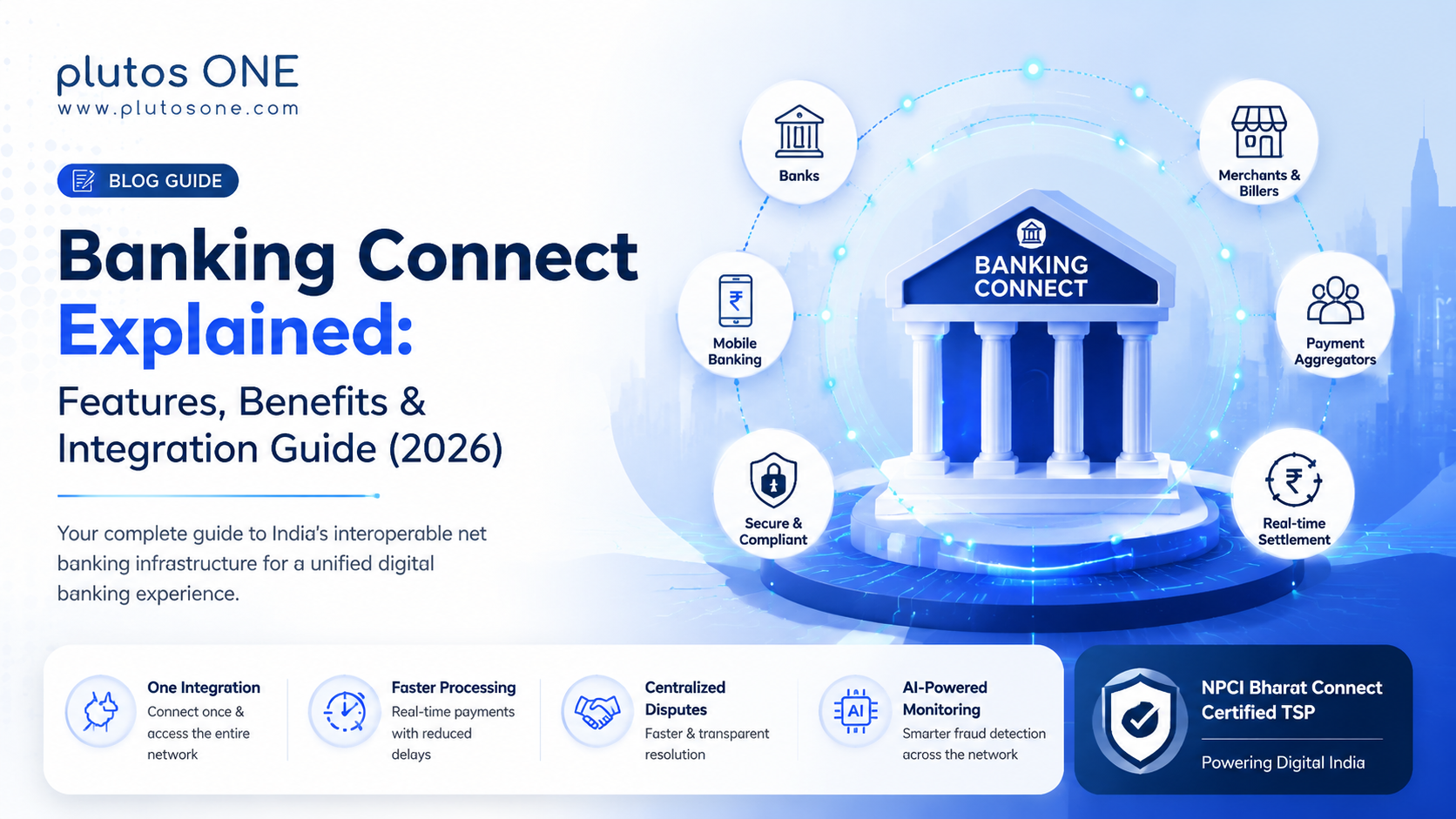
A few forces are converging to make this shift urgent rather than optional:
-
Rising transaction volumes on high-value categories. Insurance, education, and large e-commerce purchases still lean heavily on net banking, and volumes here are growing fast enough that legacy bilateral integrations can't keep pace.
-
Regulatory push for interoperability. The RBI has been explicit about wanting UPI-like interoperability extended to net banking, which is what triggered the March 2024 approval for NBBL to build this system in the first place.
-
Smaller banks getting left behind. Under the old bilateral model, only banks with the engineering bandwidth to run dozens of integrations could offer a smooth net banking experience. Banking Connect levels this by giving regional and smaller banks the same one-time integration path as the largest players — a genuine financial-inclusion angle, not just a technical upgrade.
-
AI-driven fraud monitoring built in. Rather than every bank building its own fraud stack for net banking transactions, NBBL layers in centralized AI/ML-based monitoring that flags suspicious activity across the network.
Rising transaction volumes on high-value categories. Insurance, education, and large e-commerce purchases still lean heavily on net banking, and volumes here are growing fast enough that legacy bilateral integrations can't keep pace.
Regulatory push for interoperability. The RBI has been explicit about wanting UPI-like interoperability extended to net banking, which is what triggered the March 2024 approval for NBBL to build this system in the first place.
Smaller banks getting left behind. Under the old bilateral model, only banks with the engineering bandwidth to run dozens of integrations could offer a smooth net banking experience. Banking Connect levels this by giving regional and smaller banks the same one-time integration path as the largest players — a genuine financial-inclusion angle, not just a technical upgrade.
AI-driven fraud monitoring built in. Rather than every bank building its own fraud stack for net banking transactions, NBBL layers in centralized AI/ML-based monitoring that flags suspicious activity across the network.
How Banking Connect Works
At a high level, Banking Connect sits as a routing and standardization layer between the customer's banking app and the merchant's payment request, using Bharat Connect's underlying rails to move the transaction through to settlement.
The transaction flow looks like this:
Breaking that down step by step:
-
Initiation — The customer chooses net banking or mobile banking as a payment method on a merchant or biller's checkout page.
-
Routing to the central switch — Instead of the merchant's payment aggregator hitting the bank's proprietary API directly, the request is routed through Banking Connect's standardized interface.
-
Bank authentication — The customer is redirected into their own bank's trusted authentication flow (login, OTP, or app-based approval) — the experience customers already know and trust.
-
Standardized processing — Banking Connect handles the request in a common format regardless of which bank or aggregator is on either end, using underlying rails such as NEFT, RTGS, IMPS, and intent/QR-based flows.
-
Real-time settlement — Funds move with real-time (or near real-time) settlement support, removing the multi-day lag common in older net banking flows.
-
Confirmation and reconciliation — Both the bank and the merchant/PA receive standardized transaction confirmations, with a centralized reference ID that makes reconciliation and dispute resolution far simpler than matching logs across bilateral systems.
The genuinely new part here isn't any single step — banks already had authentication, settlement, and confirmation before. What's new is that every participant now speaks the same protocol, so a transaction between any bank and any aggregator on the network behaves identically from an integration standpoint.
Key Features of Banking Connect
Initiation — The customer chooses net banking or mobile banking as a payment method on a merchant or biller's checkout page.
Routing to the central switch — Instead of the merchant's payment aggregator hitting the bank's proprietary API directly, the request is routed through Banking Connect's standardized interface.
Bank authentication — The customer is redirected into their own bank's trusted authentication flow (login, OTP, or app-based approval) — the experience customers already know and trust.
Standardized processing — Banking Connect handles the request in a common format regardless of which bank or aggregator is on either end, using underlying rails such as NEFT, RTGS, IMPS, and intent/QR-based flows.
Real-time settlement — Funds move with real-time (or near real-time) settlement support, removing the multi-day lag common in older net banking flows.
Confirmation and reconciliation — Both the bank and the merchant/PA receive standardized transaction confirmations, with a centralized reference ID that makes reconciliation and dispute resolution far simpler than matching logs across bilateral systems.
Unified bill and merchant payments. One standardized flow handles net banking payments across insurance, e-commerce, education, utilities, and B2B collections rather than category-specific integrations.
Multiple payment methods under one roof. Banking Connect standardizes across NEFT, RTGS, IMPS, and intent/QR/redirection-based flows, giving banks a UPI-like experience layered onto traditional net banking rails.
Real-time processing. Settlement happens close to real time, replacing the multi-day reconciliation cycles that used to be normal for net banking transactions.
API-first integration. Banks connect through a defined set of APIs rather than negotiating custom specs with every aggregator individually — this is the entire point of the "connect once" model.
Secure, bank-grade authentication. Customers continue authenticating through their own bank's existing login and OTP/app-approval flow, so there's no new credential surface for fraudsters to target and no retraining needed for end users.
AI/ML-based fraud monitoring. NBBL layers in machine-learning-based transaction monitoring designed to flag suspicious patterns — including higher-risk categories like crypto and gaming-linked payments — and alert banks in near real time.
Centralized dispute management. Instead of each bank-aggregator pair maintaining its own dispute process, Banking Connect gives the network a shared, standardized resolution mechanism.
Built-in reach for smaller banks. Because the integration is one-time and standardized, regional and smaller banks gain access to the same aggregator network as the largest private and public sector banks — without needing to build dozens of custom integrations first.
Benefits of Banking Connect
For Banks
Banks cut integration and maintenance overhead dramatically — one certification against the NBBL standard replaces what used to be a growing list of bilateral integrations, each with its own testing cycle. It also means smaller and regional banks can compete for aggregator relationships on equal footing with the largest players, since reach is no longer gated by engineering capacity.
For Customers
Customers get a faster, more consistent net banking experience regardless of which bank or merchant they're dealing with. Fewer failed transactions, faster settlement, and clearer recourse when something does go wrong, since disputes route through one standardized process instead of getting stuck between two institutions pointing at each other.
For Fintechs
Payment aggregators and fintech platforms building on top of Banking Connect no longer need to maintain a growing patchwork of bank-specific integrations. One connection to the network gives them access to every participating bank, which shortens go-to-market timelines for new merchant categories significantly.
For Enterprises
Large enterprises collecting payments — insurers, educational institutions, e-commerce platforms — get more predictable settlement timing and simpler reconciliation, since transaction references and confirmation formats are standardized across every bank a customer might pay from.
Banking Connect Architecture Explained
Banking Connect's architecture is built in layers, each with a clearly defined job:
-
Customer Layer — The net banking or mobile banking interface the customer actually interacts with (their own bank's app or website).
-
Banking Channel — The bank's internal net banking/mobile banking infrastructure, which now speaks Banking Connect's standardized protocol instead of a custom one per aggregator.
-
API Layer — The standardized set of APIs that both banks and payment aggregators integrate against once, covering authentication, transaction initiation, status checks, and confirmations.
-
Bharat Connect BBPS (Central Switch) — The NBBL-run switch that routes standardized requests between banks and aggregators/merchants, using the same underlying rails (NEFT/RTGS/IMPS) that already move money across India's banking system.
-
Billers/Merchants — The end recipients of the payment, plugged in through their payment aggregator without needing bank-specific logic on their side.
-
Settlement — Real-time or near-real-time fund movement between the customer's bank and the biller's bank, with a shared reference ID for reconciliation.
The strategic value of this layering is that each participant only needs to build against the API layer once. Whether a bank is connecting to two aggregators or twenty, the integration effort stays roughly flat rather than scaling linearly with every new relationship — which is exactly the cost problem the bilateral model created in the first place.
Banking Connect vs Bharat Connect (BBPS)
These two are often confused because they share the same parent organization — but they solve different problems.
In short: Bharat Connect is the payment infrastructure; Banking Connect is the net-banking-specific interoperability layer that sits on top of it. A bank or TSP working across both gets standardized rails for both recurring bill payments and high-value net banking transactions from the same underlying network.
Banking Connect vs Traditional Net Banking
Banking Connect APIs Explained
Banking Connect's API layer is designed to abstract away NPCI's underlying protocol complexity so that banks and aggregators only need to work with a simplified, well-documented set of endpoints. In practice, this typically spans:
-
Authentication — Secure onboarding and credential validation for banks and aggregators connecting to the network.
-
Bill/Payment Fetch — Pulling payment or bill details for a given transaction request in a standardized format.
-
Bill/Payment Initiation — Triggering the actual net banking or mobile banking payment through the customer's bank.
-
Status & Confirmation — Real-time status checks and standardized confirmation payloads once a transaction settles.
-
Customer & Transaction Management — Managing transaction references, correlation IDs, and ledger entries for traceability across the full transaction lifecycle.
-
Notifications — Standardized alerts for success, failure, or exception states, sent to both the bank and the merchant/aggregator side.
-
Reports & Reconciliation — Structured reporting endpoints that make end-of-day and dispute-related reconciliation far simpler than matching logs manually across bilateral systems.
The point of this API-first design isn't novelty — it's that a bank or TSP builds against this layer once, and that same integration then works across every aggregator and merchant on the network, instead of every relationship needing its own bespoke API contract.
Banking Connect Use Cases
Banking Connect is built for exactly the categories where net banking has historically been the dominant or preferred payment method for high-value or recurring transactions:
-
Utility bill payments — Electricity, water, gas, and other recurring household bills
-
Credit card bill payments — Paying credit card dues directly through net banking
-
Loan EMI payments — Recurring loan and EMI collections
-
FASTag recharge — Topping up FASTag balances through net banking
-
Insurance premium payments — High-value, often annual premium payments (one of the categories demonstrated live at the GFF 2025 launch)
-
School and education fee payments — Institutional fee collection at scale
-
Municipal tax payments — Property tax and other civic payments
-
Business collections — B2B and enterprise-level collections where net banking remains a preferred settlement method for larger ticket sizes
Security & Compliance
Because Banking Connect sits at the intersection of banking infrastructure and payment aggregation, it's built against the same regulatory and security baseline that governs the rest of India's digital payments stack:
-
RBI Guidelines — Banking Connect operates under RBI's approval for interoperable internet banking transactions, granted in March 2024, and continues to be shaped by RBI's broader digital payments and fraud-prevention priorities.
-
NPCI Standards — As an NBBL/NPCI platform, Banking Connect follows the same governance and certification model used across NPCI's other national payment systems.
-
Data Encryption — Transaction data moving through the central switch is encrypted in line with standard banking-grade security practices.
-
Authentication — Customers authenticate through their own bank's existing, trusted login and OTP/app-approval mechanisms — Banking Connect doesn't introduce a new credential layer for customers to manage.
-
Fraud Prevention — NBBL has built AI/ML-based monitoring into the platform specifically to flag suspicious transaction patterns, including closer scrutiny of higher-risk payment categories, and alert banks before settlement completes.
For any bank or TSP evaluating Banking Connect, the security model is a genuine selling point: you're not adopting a third-party vendor's proprietary security stack, you're plugging into an RBI-approved, NPCI-governed national standard.
How Banks Can Integrate Banking Connect
Integrating Banking Connect isn't a one-afternoon API call — it's a structured rollout, typically following five stages:
Step 1 — Assess Business Requirements Identify which use cases matter most (insurance collections, e-commerce, B2B payments, etc.), current net banking transaction volumes, and where existing bilateral integrations are creating the most friction or cost.
Step 2 — Choose a Technology Partner This is where most banks hit a wall. Building and maintaining direct compliance with NPCI's Banking Connect protocol in-house means dedicating engineering resources to a specification that will keep evolving — and getting it wrong risks certification delays or transaction failures in production. This is exactly the gap a certified Technology Service Provider is built to close.
plutos ONE is a certified TSP for Banking Connect, offering plug-and-play API wrappers built around NPCI's Banking Connect standard. Instead of a bank's engineering team parsing raw NPCI protocol documentation, plutos ONE abstracts that complexity into simple, well-documented APIs — so integration timelines shrink from months to weeks. The platform also handles end-to-end transaction lifecycle management (requests, responses, retries, and exceptions) from one centralized control layer instead of leaving banks to stitch together multiple fragmented systems, along with automated reconciliation, correlation ID management, and dashboard-level traceability. Underneath all of it sits a high-availability, managed switch infrastructure with built-in monitoring, audit controls, and operational resilience so banks aren't left building fraud monitoring and uptime guarantees from scratch. plutos ONE is also PCI-DSS and ISO 27001 certified, which matters given how much sensitive financial data flows through this layer.
Step 3 — API Integration Working with a certified TSP, banks integrate against the standardized API layer covering authentication, transaction initiation, status, and confirmations — a single build that then works across every aggregator on the network.
Step 4 — Testing & Certification NBBL certification testing validates that the integration correctly handles the full transaction lifecycle, including edge cases, retries, and dispute scenarios, before the bank goes live on the network.
Step 5 — Go Live Once certified, the bank is live on Banking Connect and reachable by every payment aggregator and merchant on the network — without needing a separate integration for each one.
Common Banking Connect Implementation Challenges
Even with a standardized API layer, banks going live on Banking Connect typically run into a handful of recurring challenges:
Legacy Core Banking Systems. Many Indian banks — particularly regional and smaller institutions — still run on core banking platforms that weren't designed for real-time, API-first interoperability. Bridging legacy core data into Banking Connect's standardized format often requires a translation layer rather than a direct rip-and-replace.
API Compatibility. Even with a defined standard, differences in how individual banks have implemented adjacent systems (authentication flows, session management, internal ledgers) can create compatibility friction during integration and testing.
Security Compliance. Meeting RBI and NPCI security requirements — encryption standards, authentication protocols, audit trails — adds a layer of rigor that can slow down timelines for banks without dedicated compliance-and-security engineering resources.
Customer Adoption. Even when the backend is standardized, customer-facing flows need to feel familiar. Banks have to balance adopting the new standardized rails with keeping the net banking experience recognizable to existing customers.
Reconciliation. While Banking Connect standardizes confirmation formats, banks transitioning from legacy bilateral reconciliation processes still need to rebuild internal reconciliation workflows around the new correlation ID and reporting structure.
Operational Monitoring. Maintaining 24/7 uptime, retry logic, and exception handling for a live payments rail is a genuinely different operational commitment than running a handful of bilateral integrations — which is often the strongest argument for working with a TSP that already runs this infrastructure at scale rather than building it in-house.