
What is Bharat Connect for Business?
Most B2B payments in India still run the way they did a decade ago: a supplier raises an invoice by email or WhatsApp, the buyer's accounts team keys it into their own ERP by hand, the payment lands through a bank transfer that carries no reference to the original invoice, and someone on the finance team spends the next few days matching bank statements to invoice numbers by eye. Multiply that across hundreds of suppliers and buyers, and you get exactly the kind of fragmentation thatBharat Connect (BBPS) solved for consumer bill payments a decade ago — except this time the problem sits inside enterprise finance teams and MSME back offices.
Bharat Connect for Business (BCB) — formerly referred to as BBPS for Business — is NPCI Bharat BillPay Limited's (NBBL) interoperable B2B network for invoicing, purchase orders, collections, and reconciliation. It extends the same "connect once, reach everyone" philosophy that built Bharat Connect's consumer bill-pay rail, but applies it to buyer-seller transactions.
Invoices, purchase orders, payments, and the reconciliation that ties them together all move over one standardised network instead of point-to-point integrations between every ERP, bank, and payment app a business happens to use.
It matters because India's B2B payments problem isn't a lack of digital options — UPI, NEFT, RTGS, and cards already move the money fine. What's missing is the structured link between an invoice, the purchase order it maps to, and the payment that eventually settles it. BCB is built specifically to close that gap. According toNBBL's own February 2026 announcement, India has more than 7.7 crore MSMEs generating over 150 crore GST e-invoices annually — the scale NBBL is building BCB's Digital Public Infrastructure principles around.
Where BCB Sits in the Bharat Connect Ecosystem
BCB isn't a separate network bolted onto Bharat Connect — it's built on the same NBBL-operated infrastructure and inherits the same regulatory backing, interoperability model, and central dispute-resolution framework. The difference is what it's built to standardise:
If you think of Bharat Connect as the rail that standardised how a consumer pays an electricity board, BCB is the same rail re-architected for how a distributor pays a manufacturer, or how an enterprise pays hundreds of vendors without every relationship needing its own reconciliation process.
Who Runs Bharat Connect for Business
BCB is governed and operated by NBBL, under RBI's broader Bharat Connect mandate, through a defined set of roles:
-
BBPS Central Unit (NBBL) — Runs the central switch, sets the interoperability standard, and manages the network-wide dispute-resolution framework.
-
Operating Units (OUs) — Licensed platforms (often built via a Technology Service Provider like plutos ONE) that bring banking, invoicing, and settlement capability onto the network.
-
Agent Institutions (AIs) — The front-end systems businesses already use — accounting software, ERPs, and B2B payment platforms — that plug into BCB to give buyers and sellers a native experience inside tools like Tally, without forcing them onto a new portal.
-
Banking Partners (BPs) — The banks that handle underlying settlement and act as the trust layer for fund movement between businesses.
This is a similar governance model to what NBBL runs for Banking Connect, NBBL's interoperability layer fornet banking and mobile banking payments — same parent organisation, same standardise-once philosophy, applied to a different transaction type.
Bharat BillPay for Business vs Bharat Connect for Business
The naming here trips people up, so it's worth being direct about it: Bharat BillPay for Business and BBPS for Business are the earlier names for the same platform now branded Bharat Connect for Business. NBBL rebranded BBPS to Bharat Connect in 2024 to reflect an expanded mandate — moving beyond consumer utility bills into exactly this kind of B2B infrastructure — and the "for Business" product line carried the new name forward. If you see any of these three terms in older documentation, they refer to the same underlying network.
Why Businesses Need Better B2B Payment Infrastructure
Ask any finance team running B2B collections at scale what actually eats their time, and the answer is rarely "we can't move money." It's everything around the money movement:
-
Manual invoice processing. Invoices arriving as PDFs, emails, or physical copies that someone has to re-key into an ERP or accounting system.
-
Delayed collections. No standardised way to remind a buyer that an invoice is due, so follow-up becomes a phone call or a WhatsApp message sent whenever someone remembers.
-
Fragmented payment channels. Buyers paying through whichever bank transfer, UPI handle, or payment link is convenient that day, with no consistent reference tying the payment back to an invoice.
-
Manual reconciliation. Finance teams matching bank statements against outstanding invoices line by line, often in a spreadsheet, at month-end.
-
Disconnected ERP and banking systems. A supplier's ERP has no visibility into whether their buyer's bank has actually released payment until the money lands — and even then, matching it to the right invoice is manual work.
-
Poor receivables visibility. Leadership finding out about a cash-flow crunch from an outstanding-receivables report rather than from real-time visibility into what's due, what's overdue, and what's already been collected.
None of these are money-movement problems. They're structure and standardisation problems — which is exactly what BCB is designed to solve, the same way Bharat Connect solved bill-payment standardisation and Banking Connect is solving net-banking interoperability.
How Bharat Connect B2B Payments Work
At a structural level, a transaction on BCB moves through a consistent flow, regardless of which OU, bank, or ERP is involved on either side:
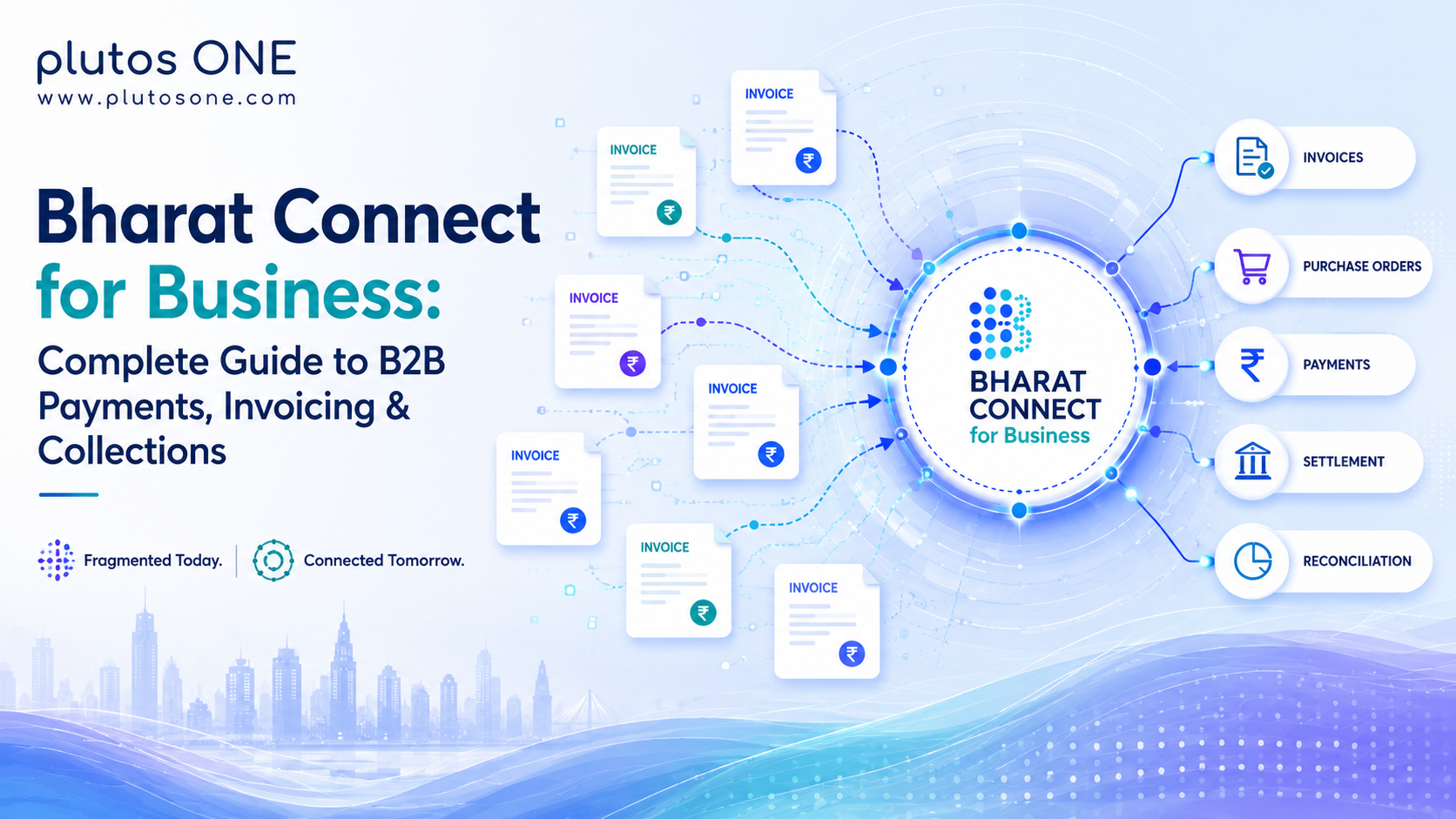
Breaking that down:
-
Onboarding — A business registers on the network and receives a unique B2B ID, verified against GST and business KYC details.
-
Discovery — Buyers and sellers search for and link with each other on the network using their B2B ID, establishing a connected relationship instead of a one-off email exchange.
-
Purchase order (optional) — For buyers who work on a PO-first model, a purchase order is raised, shared, and confirmed or rejected digitally before invoicing begins.
-
Invoice creation and delivery — The seller raises a digital invoice, which is pushed to the buyer's system — whether that's their ERP, accounting software, or a BCB-enabled portal — inside a defined acknowledgement window.
-
Acceptance — The buyer accepts, disputes, or rejects the invoice digitally, replacing the back-and-forth of email confirmations.
-
Payment — The buyer pays through their bank or payment platform, with the transaction carrying a reference back to the original invoice.
-
Settlement — Funds move between the buyer's and seller's banking partners through the network's settlement cycle.
-
Reconciliation — Because the invoice, PO, and payment all carry linked references, reconciliation happens automatically instead of through manual matching.
Onboarding — A business registers on the network and receives a unique B2B ID, verified against GST and business KYC details.
Discovery — Buyers and sellers search for and link with each other on the network using their B2B ID, establishing a connected relationship instead of a one-off email exchange.
Purchase order (optional) — For buyers who work on a PO-first model, a purchase order is raised, shared, and confirmed or rejected digitally before invoicing begins.
Invoice creation and delivery — The seller raises a digital invoice, which is pushed to the buyer's system — whether that's their ERP, accounting software, or a BCB-enabled portal — inside a defined acknowledgement window.
Acceptance — The buyer accepts, disputes, or rejects the invoice digitally, replacing the back-and-forth of email confirmations.
Payment — The buyer pays through their bank or payment platform, with the transaction carrying a reference back to the original invoice.
Settlement — Funds move between the buyer's and seller's banking partners through the network's settlement cycle.
Reconciliation — Because the invoice, PO, and payment all carry linked references, reconciliation happens automatically instead of through manual matching.
Key Features of Bharat Connect for Business
Business Onboarding
Every participant joins BCB with a verified B2B ID — entity registration, GST and KYC verification, and account activation — so that every invoice, PO, and payment on the network is tied to a confirmed business identity rather than a free-text vendor name.
Product Catalogue
Sellers can maintain SKU-level and pricing data on the network, so invoices generate against a consistent catalogue instead of being typed out line-by-line each time.
Invoice Payment & Management
Digital invoices move through creation, delivery, and acknowledgement within a defined window (commonly a 24-hour acceptance cycle), with the buyer able to accept or flag a discrepancy before payment is initiated — closing the gap where disputes used to surface only after money had already moved.
Purchase Order Management
For buyers and sellers who transact on a PO basis, BCB supports digital PO creation, edits, confirmation, rejection, and tracking — bilaterally, so both sides see the same PO status at the same time.
Business Search & Discovery
Businesses can search for and connect with counterparties already active on the network using their B2B ID, rather than relying on offline introductions or manually onboarding every new vendor relationship from scratch.
Reminders & Notifications
Automated payment reminders and due-date alerts replace the manual phone-call-and-email follow-up cycle that most collections teams still run today.
Reconciliation
Because every invoice and payment on BCB carries a linked reference, reconciliation is largely automatic — invoice-to-payment matching, outstanding-invoice tracking, and settlement status are available without a spreadsheet exercise at month-end.
Payment & Settlement
BCB supports multiple settlement paths — platform-settled transactions, external settlement relay, and manual UTR entry for payments made outside the platform — so businesses aren't forced to change how they already move money, only how that money gets tracked and matched.
Supply Chain Financing
Because invoices on BCB are digitally verified and linked to confirmed POs, they become usable collateral for structured financing. Invoice-linked financing requests can be routed to financiers directly from the platform — a meaningful complement to India's Trade Receivables Discounting System (TReDS) ecosystem, which hasalready processed over ₹7.5 lakh crore in cumulative invoice financing across 88.5 lakh discounted invoices, with default rates staying below 1%. Structured digital invoice data is exactly the kind of input that makes this financing faster and cheaper to underwrite.
Bharat Connect for MSMEs: Simplifying Business Payments
MSMEs are one of the key beneficiaries of Bharat Connect for Business, particularly businesses that manage recurring invoices, collections, and supplier payments. NBBL has positioned BCB as foundational digital infrastructure for MSME-driven manufacturing hubs, not just a convenience layer for large enterprises.
For a typical MSME, BCB changes the day-to-day in concrete ways:
-
Faster collections — digital invoices and automated reminders shrink the gap between "invoice raised" and "payment received."
-
Less manual data entry — invoices flow directly into whatever accounting software the business already uses, instead of being retyped.
-
Automated reconciliation — no more matching a bank statement against a stack of physical or PDF invoices by hand.
-
Better cash-flow visibility — real-time status on what's outstanding, what's overdue, and what's been collected, instead of finding out at month-end.
-
Access to financing — digitally verified invoices become usable inputs for supply-chain financing, which matters most for MSMEs that are typically financing-constrained.
-
Reduced operational load — less time spent on collections admin means more time spent running the business.
This is also why BCB adoption has moved fastest through the tools MSMEs already use rather than a new standalone app.Tally has built Bharat Connect directly into TallyPrime, letting suppliers and buyers exchange invoices and payment information system-to-system without leaving the accounting software they already run their business on. Per NBBL's own reporting, BCB is also already live with other ERP and business-software providers including Zoho ERP, mSwipe, Easebuzz, and Open — a strong signal of where this network is headed: invisible infrastructure inside existing tools, not another login to manage.
Bharat Connect ERP Integration: Connecting Invoices, Payments & Accounting
BCB's real leverage shows up when it connects directly into the systems finance teams already use, rather than sitting as a separate portal they have to check.
ERP → Invoice → Buyer → Payment → Settlement → Reconciliation — when this loop runs inside an ERP or accounting platform, the finance team's job shrinks to reviewing exceptions, not re-entering data.
This matters differently depending on who's integrating:
-
Enterprises get invoice, PO, and payment data flowing directly into SAP, Oracle, or whichever ERP runs their finance stack — no bolt-on portal for the finance team to check separately.
-
MSMEs get the same capability inside lighter tools like Tally or cloud accounting software, without needing enterprise-grade IT resources to build a custom integration.
-
Accounting and ERP platforms get a standardized API layer to build against once, instead of negotiating a separate data-exchange format with every bank and payment partner their customers use.
-
ERP providers get to offer "connected B2B payments" as a native feature rather than a third-party workaround, which is a meaningful product differentiator in a competitive ERP market.
Bharat Connect for Banks, Fintechs, Enterprises & MSMEs
For Banks
Banks can participate as a Banking Partner or Operating Unit on BCB, offering B2B payment, invoicing, and collections capability to their SME and corporate banking customers without building bilateral integrations with every ERP or payment platform those customers use. It's also a natural extension of the same BOU/COU-style participation banks already run on the consumer side ofBharat Connect.
For Fintechs
Fintechs can offer embedded B2B payments, invoicing, and collections inside their existing platforms by integrating BCB's APIs through an Operating Unit or Technology Service Provider, rather than building invoice-matching and reconciliation logic from scratch.
For Enterprises
Large enterprises managing hundreds or thousands of supplier and buyer relationships get a standardised way to process supplier payments, run customer collections, and automate invoice reconciliation — with ERP integration removing the manual step of moving data between finance systems and payment execution.
For MSMEs
MSMEs get the lightest-weight path onto the network — invoicing, collections, and reconciliation running inside accounting tools they already use, without needing dedicated IT resources to build or maintain a custom integration.
Bharat Connect for Business API: What Can You Integrate?
For anyone evaluating BCB from a build perspective, the API surface generally covers:
In practice, very few businesses integrate against NBBL's raw specification directly. Most go through a licensed and empanelled Technology Service Provider that has already built, tested, and certified a wrapper around these APIs — which is the same pattern that's standard across Bharat Connect and Banking Connect integrations.
Benefits of Bharat Connect for Business
Bharat Connect Reconciliation: Simplifying Accounts Receivable & Payable
Reconciliation is where most of the manual pain in B2B finance actually lives, so it's worth going deeper here. In a traditional setup, a finance team is matching three disconnected records: the invoice raised, the purchase order it maps to (if any), and the payment that eventually clears — often across different systems, sometimes without a shared reference number at all.
BCB removes the disconnection by carrying linked references through the entire lifecycle:
-
Invoice-to-payment matching happens automatically because the payment carries a reference back to the invoice it's settling.
-
Transaction status — pending, accepted, disputed, paid, settled — is visible in real time rather than inferred from a bank statement.
-
Outstanding invoices are tracked centrally, so a finance team can see exactly what's overdue without cross-referencing spreadsheets.
-
Settlement information flows back from the Banking Partner side, closing the loop between "payment initiated" and "funds actually settled."
The net effect: what used to be a manual, end-of-month reconciliation exercise becomes closer to real-time bookkeeping.
How Bharat Connect for Business Improves Collections
The full collection cycle on BCB runs: Invoice → Reminder → Payment → Settlement → Reconciliation
What changes for a collections team:
-
Automated reminders replace manual follow-up calls and emails as invoices approach or pass their due date.
-
Payment tracking gives real-time visibility into which invoices are paid, pending, or overdue.
-
Faster collections result from reducing the friction between "invoice sent" and "buyer pays" — digital delivery, digital acceptance, and a direct payment path.
-
Reduced follow-up load frees up collections staff to handle genuine exceptions instead of routine chasing.
-
Better receivables visibility gives finance leadership a real-time view of cash coming in, rather than a lagging monthly report.
Bharat Connect vs Traditional B2B Payment Systems
How to Integrate Bharat Connect for Business
Step 1: Define the business use case. Decide whether the priority is invoicing, collections, ERP integration, supply-chain financing, or a combination — this shapes which parts of the API suite matter most.
Step 2: Choose an integration partner. Building and maintaining direct compliance with NBBL's BCB specification in-house is a meaningful engineering commitment. A licensed and empanelled Technology Service Provider that has already been through NBBL certification is typically the faster, lower-risk route.
Step 3: Complete business onboarding. Register the business and its counterparties on the network with verified B2B IDs.
Step 4: Integrate required APIs. Connect onboarding, invoice, PO, payment, reminder, and reconciliation APIs relevant to the chosen use case.
Step 5: Testing & certification. Complete NBBL's mandated testing cycle to confirm invoice, PO, payment, and reconciliation flows meet network standards.
Step 6: Go live. Launch B2B invoicing, collections, and reconciliation capability across the full BCB network.
Step 7: Monitor transactions and reconciliation. Use real-time dashboards to track outstanding invoices, payment status, and settlement — rather than reconstructing this view manually after the fact.
Bharat Connect for Business Use Cases
MSME Collections — Automating invoice delivery and reminders for a small manufacturer or distributor chasing payment from dozens of buyers.
Enterprise Invoice Payments — Large enterprises processing high invoice volumes across hundreds of suppliers with automated reconciliation instead of manual matching.
Supplier Payments — Buyers issuing digital purchase orders and settling supplier invoices with a linked, auditable payment trail.
Corporate Collections — Enterprises collecting from a large, distributed customer base with standardised reminders and real-time receivables visibility.
ERP & Accounting Platforms — Software providers (like Tally) embedding BCB directly so their users transact without leaving the accounting tool they already use.
B2B Fintech Platforms — Fintechs offering embedded invoicing, payments, and collections as a feature inside their existing product.
Supply Chain Financing — Financiers using digitally verified BCB invoice data to underwrite working-capital loans faster and with lower risk.
How plutos ONE Helps Businesses Integrate Bharat Connect for Business
plutos ONE is a certified Technology Service Provider (TSP) for Bharat Connect for Business, built to take on the integration and compliance work so banks, fintechs, and enterprises don't have to build against NBBL's raw specification themselves:
-
Ready-to-consume APIs covering onboarding, invoicing, purchase orders, payments, and reconciliation
-
Certification support — NBBL certification, test cases, and UAT coordination
-
White-labelled buyer and seller portals for invoice creation, PO management, and reconciliation dashboards
-
Ongoing technical support, including a dedicated integration Relationship Manager and post-launch hypercare
plutos ONE is also PCI-DSS and ISO 27001 certified. If you're evaluating how to bring B2B invoicing, collections, and reconciliation onto Bharat Connect for Business then Plutos ONE covers the full API suite and integration model in more detail.
The Future of B2B Payments in India
The direction of travel here is clear: B2B payments in India are moving from a collection of disconnected steps — invoice, payment, reconciliation, financing — toward a single connected chain where each step feeds the next automatically.
According toNBBL's official February 2026 press release, Bharat Connect for Business — launched in 2024 — surpassed two million invoice-based transactions in Q3 FY26 alone, with average month-on-month growth of 50% in invoice generation over the preceding six months. The platform is already live with ERP and business-software providers including TallyPrime, Zoho ERP, mSwipe, Easebuzz, and Open.
Layer in the momentum already building in adjacent infrastructure —TReDS crossing ₹7.5 lakh crore in cumulative invoice financing with default rates staying below 1%, and NBBL positioning BCB as core Digital Public Infrastructure for India's 7.7 crore-strong MSME sector — and the pattern is consistent: Invoices + Payments + Collections + Reconciliation + Settlement + Financing, all running on one interoperable rail instead of six disconnected systems.
Bharat Connect for Business is the piece of that stack built specifically for how businesses actually transact with each other. For banks, fintechs, enterprises, and MSMEs looking to adopt Bharat Connect for Business, working with a certified Technology Service Provider such asplutos ONE can simplify integration, certification, and ongoing operations.