
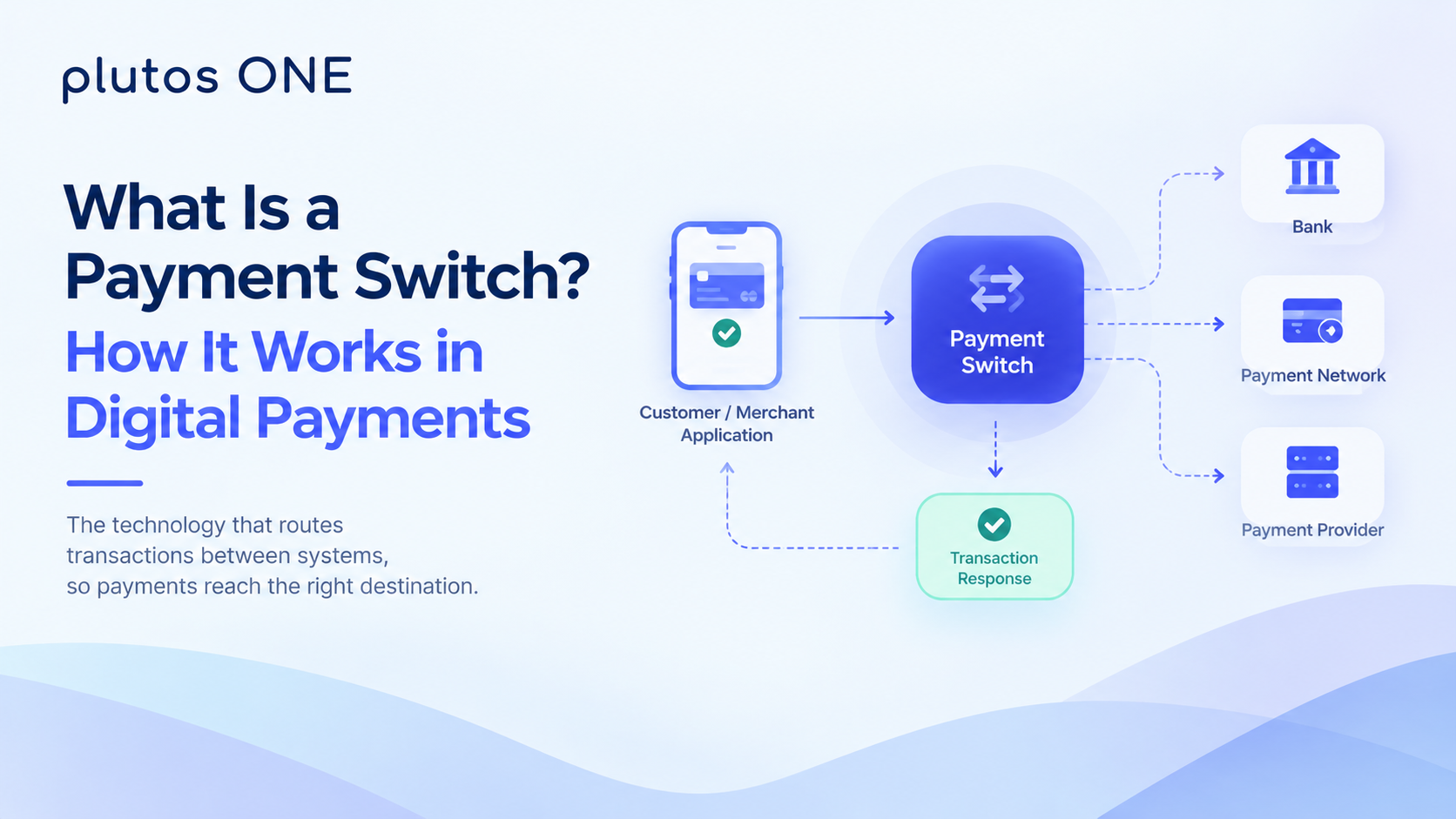
Digital payments involve several systems working together. When a customer makes a payment, the transaction request must reach the right bank, payment network, or processing system before a response can be returned.
A payment switch helps manage this flow. It routes transaction messages between connected systems according to the rules and requirements of the payment setup.
For banks, fintech companies, and businesses managing multiple payment connections, understanding payment switching can help when planning or upgrading payment infrastructure.
What Is a Payment Switch?
A payment switch is a technology layer that receives payment transaction messages and forwards them to the appropriate connected system.
For example, when a payment is initiated through a banking application, the request may need to pass through several connected systems before the transaction can be processed. The payment switch manages the routing step, helping the systems communicate through the required transaction flow.
The specific role of a switch depends on the payment network and architecture. In some environments, it handles routing within a bank or payment network; in others, it connects multiple processing systems.
How Does a Payment Switch Work?
Consider a customer initiating a digital payment through a bank’s application. The request must be processed by the systems responsible for that particular payment service.
A typical payment-switching flow involves four stages:
-
Receiving the transaction: The switch receives a transaction message from a connected application or system.
-
Applying routing rules: It determines where the request should be sent based on the configured rules and supported connections.
-
Forwarding the request: The transaction message is sent to the relevant system for further processing.
-
Returning the response: The resulting status is passed back through the connected systems to the originating application.
The switch routes the request; it does not necessarily make the final decision to approve or reject the payment. That decision depends on the systems responsible for authorisation and processing.
The flow can differ across payment methods, networks, and implementations.
Why Is Payment Switching Important?
As banks and businesses add payment channels and integrations, managing transaction flows becomes more complex. A payment switch can help address several operational needs.
-
Managing system connectivity: A central switching layer can simplify how connected systems exchange transaction messages.
-
Applying routing rules: Transactions can be directed according to the requirements of the payment setup.
-
Supporting transaction monitoring: When integrated with monitoring tools, transaction records can help teams investigate errors and track processing status.
-
Accommodating growth: A suitable architecture can make it easier to manage additional connections as payment services expand.
These benefits depend on the switch's capabilities and implementation. Features such as automatic failover, advanced routing optimisation, and real-time performance-based decisions should not be assumed to be available in every solution.
Payment Switch vs Payment Gateway vs Payment Orchestration
These terms are related, but they describe different functions within payment infrastructure.
An organisation may use one or more of these capabilities together. The distinction depends on the architecture and the functions provided by each platform.
Learn more in our guide toPayment Gateway vs Payment Aggregator
What Should You Consider When Choosing a Payment Switch?
The right solution depends on how your payment systems operate today and what they need to support in the future.
Before selecting a payment switch, consider:
-
Integration requirements: Can it connect with the banks, networks, and applications your organisation uses?
-
Transaction handling: Does it support the required message formats, routing rules, and transaction flows?
-
Security and controls: Are security measures, access controls, audit trails, and applicable compliance requirements addressed?
-
Monitoring and support: Can teams investigate failed or delayed transactions and understand their status?
-
Scalability and resilience: Is the architecture suitable for expected transaction volumes, recovery requirements, and future integrations?
For regulated financial services, technical suitability should be assessed alongside the organisation’s applicable regulatory, contractual, and network obligations.
How Plutos ONE Fits Into Payment Infrastructure
Payment switching is one part of a broader payment infrastructure environment. Banks and financial institutions also need to manage system integrations, monitor transaction activity, and handle reconciliation and operational workflows.
Plutos ONE provides payment infrastructure for banks and businesses, with capabilities that include centralised switching and orchestration. ItsOrbit platform brings together operational capabilities such as transaction monitoring, reconciliation, compliance, ticketing, and operational monitoring.
The company is also exploring the future of payment technology through its announced collaboration with Lyra Network. According tothe MoU announcement published by CXO Digital Pulse, the two companies intend to work towards next-generation, AI-enabled payment solutions.
This collaboration provides a broader example of how payment technology providers are exploring new approaches to digital payments. The specific solutions and deployment details should be distinguished from the capabilities already available in a company's products.
ExplorePlutos ONE's payment infrastructure to learn more.