
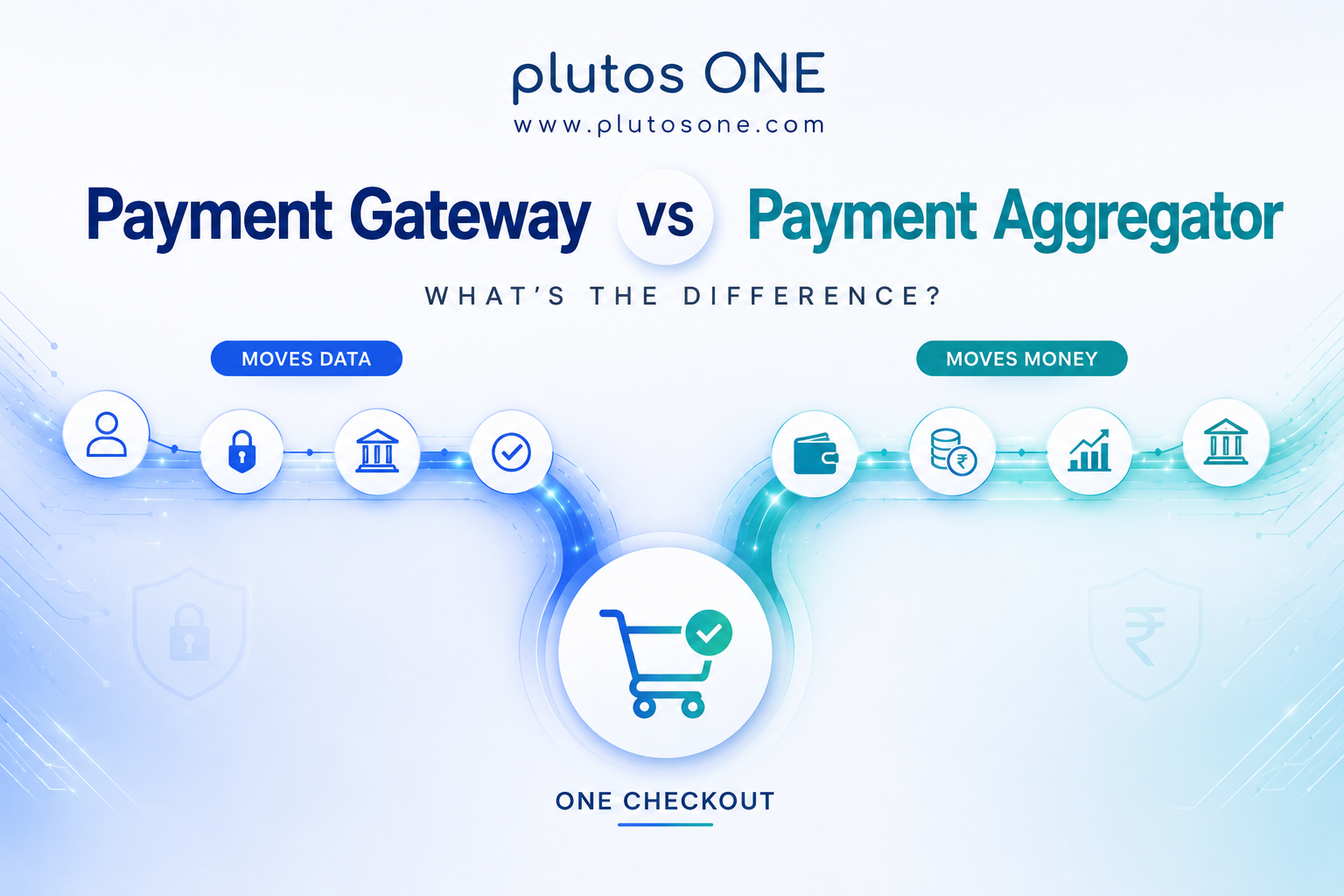
"Payment gateway" and "payment aggregator" get used interchangeably in most everyday conversation, but they perform different roles in how a business accepts money online.
Payment gateways and payment aggregators are both important parts of the online payment ecosystem, but they perform different roles. While a payment gateway primarily provides the technology to securely route payment transactions, a payment aggregator enables businesses to accept multiple payment methods through a single integration and manages the associated merchant payment flow.
Understanding the difference between a payment gateway and a payment aggregator can help businesses choose the right payment solution for their payment acceptance, integration, settlement, and compliance requirements.
Introduction: Payment Gateway vs Payment Aggregator
The short version: a payment gateway is the technology layer that securely routes a transaction from a customer's payment method to the bank that processes it — it never actually holds the money. A payment aggregator goes a step further: it onboards merchants under its own master account, accepts payments from customers, pools those funds, and settles them to the merchant afterward — meaning it does hold the money, briefly, in transit.
That one difference — does this entity touch the funds or not — is also exactly the line India's regulator draws between the two.
What Is a Payment Gateway?
Payment Gateway Meaning
A payment gateway is technology infrastructure that authenticates and routes an online payment transaction between a customer, a merchant, and the banks or card networks involved — without holding or pooling any funds itself. It's the digital equivalent of a card-swipe machine: it passes the transaction through securely and returns a success or failure response.
How a Payment Gateway Works
-
A customer enters payment details at checkout.
-
The gateway encrypts the data and sends it to the acquiring bank or card network for authorisation.
-
The issuing bank approves or declines the transaction.
-
The response is passed back through the gateway to the merchant's checkout page in seconds.
The gateway's job ends there — it doesn't manage settlement to the merchant's account or maintain a merchant onboarding relationship on its own.
What Is a Payment Aggregator?
Payment Aggregator Meaning
A payment aggregator is an entity that lets multiple merchants accept a range of payment instruments through a single integration, without each merchant needing its own separate merchant account with a bank. The aggregator receives customer payments into a pooled account, then settles funds to individual merchants after a defined cycle.
How a Payment Aggregator Works
-
A merchant onboards under the aggregator's master merchant account instead of applying for its own.
-
Customer payments — cards, UPI, wallets, net banking — are collected into the aggregator's pooled settlement account.
-
The aggregator reconciles which funds belong to which merchant.
-
Funds are settled to each merchant's bank account, typically on a T+1 or T+2 cycle.
Because the aggregator briefly holds customer funds before passing them on, it's carrying meaningfully more regulatory and operational responsibility than a pure gateway.
Payment Gateway vs Payment Aggregator: Key Differences
In simple terms: a payment gateway primarily handles the technology and transaction-routing layer, while a payment aggregator also handles merchant payment collection and settlement responsibilities. Payment ecosystems can involve layered participants and different operating models, so this is a useful simplification rather than an exhaustive description of every setup.
Payment Gateway vs Payment Aggregator: Which One Does a Business Need?
-
If you already have a direct merchant account with an acquiring bank and just need the technical rails to process transactions, a payment gateway is the leaner fit.
-
If you want to accept UPI, cards, wallets, and net banking through one integration without negotiating separate merchant relationships with every bank, a payment aggregator does more of that work for you.
-
Most small and mid-sized online businesses in India today use an aggregator precisely because it removes the need to become a merchant-of-record with multiple banks individually.
Benefits of Using a Payment Gateway
-
Direct control over the merchant relationship and settlement terms with your acquiring bank
-
Often lower per-transaction cost for high-volume businesses that can negotiate directly
-
No funds pooled by a third party — money moves straight between the customer's bank and yours
-
Suited to businesses that already have banking and compliance infrastructure in place
Benefits of Using a Payment Aggregator
-
Single integration for multiple payment methods, instead of managing several bank relationships
-
Faster merchant onboarding — no need to independently qualify for a merchant account with each bank
-
Aggregator typically manages a chunk of the compliance and settlement operations on your behalf
-
Better fit for smaller businesses and marketplaces without dedicated banking-relationship teams
Payment Gateway vs Payment Aggregator in India
India regulates this distinction explicitly. The RBI'sGuidelines on Regulation of Payment Aggregators and Payment Gateways (Circular DPSS.CO.PD.No.1810/02.14.008/2019-20, originally dated 17 March 2020) draws the regulatory line at fund handling:
-
Payment Aggregators are required to obtain RBI authorisation under the Payment and Settlement Systems Act, 2007, meet minimum net-worth requirements, and settle merchant funds only through an escrow arrangement with a scheduled commercial bank — because they handle customer funds directly.
-
Payment Gateways, since they don't touch funds at any point, are treated as technology or outsourcing partners to banks and non-banks, with baseline technology-related recommendations rather than a full authorisation requirement.
The RBI has continued to update and clarify this framework since it first came into effect, including subsequent notifications on cross-border payment aggregators and other operational clarifications — so this fund-handling distinction is the durable principle to hold onto, even as the specific compliance requirements around it continue to evolve. For the current, complete requirements, the RBI's own notification is the authoritative reference.
Payment Aggregator vs Payment Processor: Are They the Same?
Not quite, though the terms overlap. A payment processor is the entity — often working on behalf of an acquiring bank — that actually executes the transaction: authorising, clearing, and settling it with the relevant card networks or payment rails. A payment aggregator typically works with a processor (or is one, depending on how it's structured) but adds the merchant-facing layer on top: onboarding, pooled collection, and multi-method acceptance under one integration. In practice, many aggregators bundle processing into their offering, which is part of why the distinction blurs in everyday use.
Can Payment Gateways and Payment Aggregators Work Together?
In practice, these aren't always competing choices — they often sit in the same stack:
Customer → Aggregator (onboarding, pooling) → Gateway/Processing Layer (routing, authorisation) → Bank/Network → Merchant
A payment aggregator frequently uses a payment gateway underneath it to handle the actual transaction routing and authorisation, while the aggregator layer handles merchant onboarding, fund pooling, and settlement. From a business's point of view, you may only ever interact with the aggregator's dashboard, without needing to know which gateway is doing the routing behind it.
This layered model is also why reconciliation matters so much once a business scales — money is now passing through a gateway, an aggregator's pooled account, and eventually the merchant's bank account, and each of those needs to be matched against the others. Ourcomplete guide to payment reconciliation covers exactly how that matching process works across multiple payment layers like this.
How to Choose the Right Payment Solution for Your Business
-
Transaction volume — high-volume businesses often get better economics negotiating directly with a gateway and acquiring bank; smaller businesses usually save time with an aggregator.
-
Payment method coverage — if you need UPI, cards, wallets, and net banking on day one, an aggregator's single integration is faster to launch.
-
Compliance appetite — if you'd rather not manage escrow accounts, settlement cycles, and RBI authorisation exposure yourself, an aggregator absorbs more of that.
-
B2B vs consumer flows — if what you actually need is invoicing, purchase orders, and collections between businesses rather than a checkout page, that's a different problem entirely — closer to whatBharat Connect for Business is built for than either a gateway or an aggregator.
-
Net banking specifically — if net banking is a significant share of your payment mix, it's worth knowing thatBanking Connect, NBBL's interoperable net-banking standard, is built to serve payment aggregators directly through a standardised IBMB integration rather than requiring separate bank-by-bank net banking integrations. See thecomplete Banking Connect guide for how that works.
Frequently Asked Questions About Payment Gateways & Aggregators
Q1. What is the difference between a payment gateway and a payment aggregator?
A payment gateway only routes and authorises transactions without touching funds. A payment aggregator onboards merchants under its own account, collects and pools customer payments, and settles them to merchants afterward.
Q2. What is a payment gateway?
A payment gateway is the technology infrastructure that securely transmits payment information between a customer, merchant, and the banks involved in authorising a transaction.
Q3. What is a payment aggregator?
A payment aggregator is an entity that lets multiple merchants accept various payment methods through one integration, pooling customer payments before settling them to individual merchants.
Q4. How does a payment gateway work?
It encrypts and routes payment data from checkout to the acquiring bank or card network, then returns an approval or decline response — typically in seconds.
Q5. How does a payment aggregator work?
It onboards a merchant under its master account, collects customer payments into a pooled account, and settles funds to the merchant after reconciling which amounts belong to whom.