
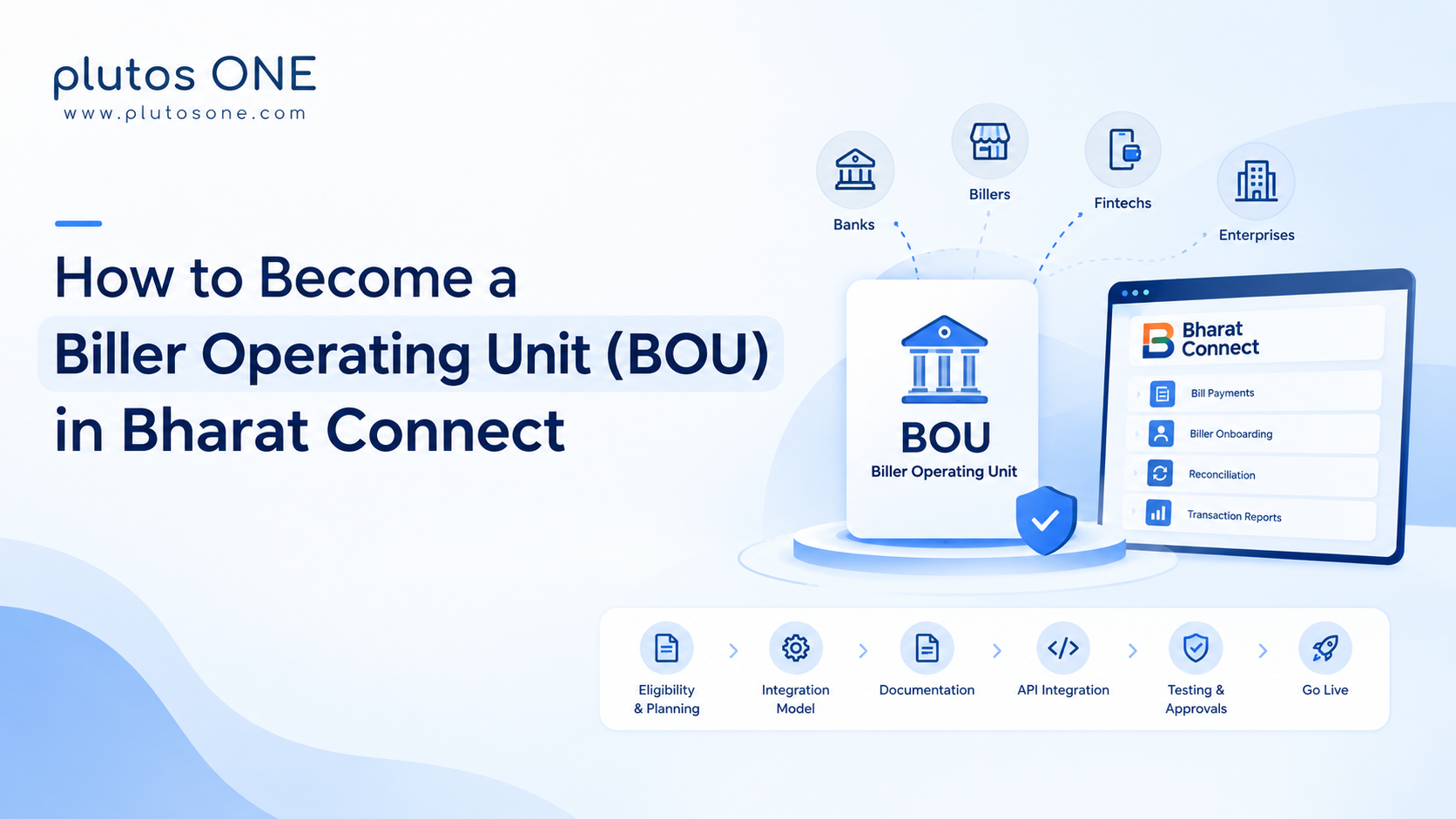
India’s digital payments ecosystem is expanding beyond traditional bill payments. Banks, financial institutions, fintech companies, and enterprises are looking for reliable ways to connect billers, streamline payment collections, and improve transaction visibility. Bharat Connect, formerly known as the Bharat Bill Payment System (BBPS), provides an interoperable framework that helps bring bill payment services together.
For organisations looking to participate in this ecosystem, becoming a Biller Operating Unit (BOU) in Bharat Connect can be an important step towards enabling biller onboarding and managing bill payment operations.
But how does the BOU onboarding process work? What technology and operational capabilities are required? And how can a Technology Service Provider (TSP) simplify integration?
This guide explains the role of a BOU, the key steps involved in onboarding, the technology requirements, and how organisations can prepare to participate in the Bharat Connect ecosystem.
What Is a Biller Operating Unit (BOU) in Bharat Connect?
A Biller Operating Unit (BOU) is an entity within the Bharat Connect ecosystem that supports biller onboarding and the processing of bill payments through the network, in accordance with the applicable operating framework.
A BOU helps connect billers with the Bharat Connect infrastructure, enabling them to participate in a standardised bill payment ecosystem. It also supports operational processes associated with transactions, settlement, service-level commitments, and risk management, as applicable to its role.
Without an interoperable bill payment framework, billers may need to manage multiple integrations and payment channels independently. Bharat Connect helps simplify this process by providing a common network through which participating entities can support bill payment services.
For banks, financial institutions, NBFCs, and eligible enterprises, BOU participation can help expand bill payment capabilities and establish structured processes for connecting billers to the network.
How Does a BOU Work in Bharat Connect?
A BOU operates as part of the broader Bharat Connect ecosystem, connecting billers with the network and supporting the processes required to facilitate bill payments.
A simplified view of the process is:
-
Biller onboarding: The organisation coordinates the onboarding of eligible billers and the required documentation, technical details, and approvals.
-
Technical integration: The necessary systems and APIs are integrated with the Bharat Connect framework through the applicable network and service-provider arrangements.
-
Bill presentment: Customers can retrieve bill details through supported participating channels, subject to the relevant biller's capabilities.
-
Payment processing: Customers initiate payments through participating channels, and transactions are processed according to the network's prescribed workflows.
-
Settlement and reconciliation: Transaction records, settlement information, and reports help participating entities track payments and reconcile operational data.
-
Ongoing operations: Monitoring, exception handling, service-level management, and risk controls help maintain reliable bill payment services.
The exact responsibilities and transaction flows depend on the entity's approved role, the integration model, and the applicable Bharat Connect requirements.
Who Should Consider Becoming a BOU?
BOU participation may be relevant to organisations that want to enable biller participation in Bharat Connect and build or expand their bill payment infrastructure.
Potentially relevant organisations include:
1. Banks
Banks can explore BOU participation to expand their biller network and strengthen their presence in digital bill payment services.
2. NBFCs and Financial Institutions
Eligible financial institutions may explore the BOU model to support relevant bill collection use cases, subject to applicable participation requirements.
3. Fintech Companies
Fintechs looking to build payment infrastructure or support biller integrations can assess whether direct participation or a TSP-supported model is appropriate for their business.
4. Enterprises and Bill Payment Businesses
Eligible enterprises with suitable use cases may explore participation or partner with an authorised entity to connect billers and facilitate collections.
Important: Not every business automatically qualifies to operate as a BOU. Eligibility, authorisation, empanelment, and other requirements must be verified against the current rules applicable to the proposed participant.
How to Become a Biller Operating Unit (BOU) in Bharat Connect
The onboarding journey depends on whether an organisation intends to pursue the applicable direct authorisation route or work through an eligible, authorised and appropriately empanelled technology partner.
The following steps provide a practical overview of the preparation and integration journey.
Step 1: Understand the BOU Role and Participation Requirements
Before beginning the process, determine the role your organisation intends to perform within Bharat Connect.
Review the applicable participation framework, eligibility conditions, authorisation requirements, operational responsibilities, and technical standards.
Your organisation should establish clarity on:
-
The biller categories and use cases it intends to support.
-
Its proposed role in the Bharat Connect ecosystem.
-
The applicable authorisation and empanelment route.
-
Settlement, reporting, complaint-handling, and risk-management responsibilities.
-
The technical and operational resources required for ongoing participation.
This assessment helps determine whether a direct participation route or a TSP-supported integration model is more appropriate.
Step 2: Evaluate the Direct Route Versus a TSP Partnership
Organisations generally need to assess the requirements of their chosen participation model before investing in implementation.
A direct route may involve meeting the applicable eligibility, authorisation, technical, security, and operational requirements. The precise process should be confirmed with the relevant network authority.
A TSP-supported route may help an eligible organisation access existing integration capabilities and implementation support without independently building every component of the payment infrastructure.
When evaluating a TSP, consider:
-
Its current authorisation and empanelment status for the required service.
-
Its experience with Bharat Connect integrations.
-
API documentation and integration support.
-
Biller onboarding and approval tracking capabilities.
-
Transaction monitoring and reconciliation tools.
-
Operational support, incident management, and reporting.
-
Security controls and applicable compliance certifications.
The appropriate model depends on the organisation's role, eligibility, business objectives, and applicable network requirements.
Step 3: Prepare Biller Information and Documentation
Biller onboarding requires accurate information and coordination between the participating organisation, the biller, and the relevant network or service provider.
Depending on the biller category and applicable requirements, preparation may involve:
-
Biller identity and business information.
-
Authorisation and supporting documents.
-
Relevant billing and collection details.
-
Technical integration specifications.
-
Bill-fetch and payment-related information.
-
Settlement and reconciliation requirements.
-
Applicable compliance and operational documentation.
The exact documentation checklist should be obtained from the relevant onboarding team. Requirements can vary by biller category and use case.
Preparing the required information in advance can help reduce avoidable delays during review and integration.
Step 4: Complete API Integration
API integration is a key part of enabling bill payment functionality.
The systems involved must support the relevant transaction workflows and comply with the applicable Bharat Connect technical specifications.
Depending on the use case, integration may cover:
-
Biller discovery and bill-fetch requests.
-
Bill validation and transaction initiation.
-
Payment processing and transaction-status handling.
-
Payment confirmations and callbacks, where applicable.
-
Error handling and transaction-status enquiries.
-
Transaction reporting and reconciliation.
-
Complaint and exception-handling workflows.
Integration teams should validate request and response formats, authentication mechanisms, security requirements, timeout behaviour, duplicate-request handling, and failure scenarios.
A well-planned integration should account for both successful and unsuccessful transactions. It should also define how pending or uncertain transaction statuses will be investigated and resolved.
Step 5: Complete Testing, Review and Required Approvals
Before production launch, the relevant systems and workflows must undergo the testing, review, and certification processes required by the applicable participation model.
Testing should cover the full transaction lifecycle rather than only the successful payment scenario.
Key areas include:
-
Bill-fetch accuracy and validation.
-
Payment request and response handling.
-
Transaction status and confirmation.
-
Failure, timeout, and retry scenarios.
-
Reconciliation and settlement records.
-
Security and access controls.
-
Operational monitoring and reporting.
-
Required network reviews and approvals.
The precise certification and approval process should be confirmed with the applicable network authority and technology partner.
Step 6: Complete Production Onboarding and Go Live
Once the required integration, reviews, and approvals are completed, the implementation can progress towards production activation.
Production readiness should include validated configurations, operational ownership, monitoring procedures, escalation contacts, and access to transaction reports.
A structured onboarding process should track key milestones such as:
-
Initial setup.
-
API integration.
-
Functional specification review.
-
Biller data and approval stages.
-
Biller ID creation or activation, where applicable.
-
Integration review and code checks.
-
Production readiness and go-live approval.
Centralised milestone tracking can help stakeholders identify pending tasks, coordinate dependencies, and maintain visibility throughout the implementation.
Step 7: Monitor Transactions and Manage Ongoing Operations
Going live is only the beginning of the operational journey.
A BOU must manage the responsibilities associated with its approved role, including relevant service-level commitments, risk controls, transaction monitoring, settlement processes, and operational reporting.
Ongoing activities may include:
-
Monitoring transaction performance and exceptions.
-
Reviewing settlement and reconciliation reports.
-
Coordinating with billers and relevant network participants.
-
Investigating failed, pending, or disputed transactions.
-
Managing complaints and escalations.
-
Reviewing service-level performance.
-
Maintaining applicable compliance and risk-management controls.
Reliable monitoring and reporting help organisations maintain operational visibility and identify issues that require timely attention.
What Technology Is Required for BOU Integration?
A BOU implementation requires more than an API connection. Organisations need a combination of integration capabilities, operational workflows, and monitoring tools to support the bill payment lifecycle.
The following table outlines key areas to evaluate.
The specific requirements will depend on the organisation's role and the applicable network specifications.
How Plutos ONE Supports BOU Onboarding
Plutos ONE provides Bharat Connect bill payment technology and onboarding support for organisations looking to connect billers and manage bill payment operations.
Its BOU offering combines integration capabilities with operational tools designed to improve visibility across the onboarding and payment lifecycle.
1. Structured Biller Onboarding with Plutos ONE Orbit
Biller onboarding involves multiple stages, stakeholders, and approvals. Plutos ONE highlights onboarding support and centralised progress tracking through its Orbit platform.
The platform is designed to help teams monitor onboarding milestones, approvals, compliance activities, and go-live progress.
This visibility can help stakeholders identify pending dependencies and coordinate the activities required to move an integration towards production.
API integration is central to enabling bill payment functionality. Plutos ONE offers API-related integration support for its Bharat Connect solutions. Organisations can explore the available API documentation and discuss their specific use cases with the onboarding team. The integration scope, required APIs, testing process, and implementation timelines should be confirmed for each project. Some billers, including educational institutions, NGOs, microfinance institutions, and donation centres, may operate through offline or fragmented systems. Plutos ONE's Orbit Offline ERP is designed to help connect such billers with the Bharat Connect ecosystem and streamline the bill payment lifecycle across supported digital and physical channels. This can be relevant to organisations seeking to bring additional billers into a structured digital payment environment. The Unified Presentment Management System (UPMS) supports recurring payment use cases through standing instructions, where applicable. For supported billers and payment scenarios, this can help customers automate eligible recurring bill payments instead of relying entirely on manual payment reminders. UPMS functionality and availability depend on the relevant use case and applicable network requirements. Plutos ONE also highlights NBBL Bharat QR as part of its BOU offering. A dynamic, amount-specific QR code can carry relevant transaction and bill information, allowing customers to scan and authorise a payment without manually entering the amount. This can support convenient payment experiences for eligible use cases, subject to the applicable integration and network specifications. Transaction visibility is essential for bill payment operations. Plutos ONE highlights automated reconciliation through Orbit and daily transaction reporting as part of its offering. These capabilities are designed to help participating teams review transaction information, track operational activity, and manage reconciliation workflows with greater visibility. The exact reports, reconciliation processes, and settlement responsibilities should be confirmed for the proposed implementation. A reliable bill payment implementation requires support beyond the initial integration. Plutos ONE highlights 24×7 operations and operational support as part of its BOU offering. Its product page also lists a 99.9% uptime figure. Prospective partners should confirm the applicable service-level commitments, support scope, monitoring arrangements, and uptime measurement methodology during evaluation. A well-planned BOU implementation can support the following operational and business objectives. A structured integration model can help participating organisations onboard eligible billers and connect them to the Bharat Connect ecosystem through the applicable network framework. Using the prescribed network workflows can help organisations manage bill presentment and payment processing more consistently across supported use cases. Centralised tracking can make it easier to follow documentation, integration, approval, and production-readiness milestones. Automated reporting and reconciliation tools can reduce manual effort and help teams identify discrepancies that require investigation. Where supported, UPMS and standing instructions can help enable recurring bill payments and reduce dependence on manual payment initiation. Monitoring, escalation procedures, risk controls, and service-level tracking can help participating organisations manage their ongoing responsibilities more effectively. The outcomes achieved will depend on the organisation's implementation, transaction volumes, biller mix, operating model, and the capabilities included in its solution. Understanding common implementation challenges can help organisations plan more effectively. Missing or inconsistent information can delay review and approval. A defined checklist and clear ownership of documentation can help address this challenge. API integration often requires coordination between technical teams, billers, service providers, and relevant network stakeholders. Clear milestones and early testing can help surface issues sooner. Timeouts and uncertain transaction outcomes require well-defined status-checking, exception-handling, and reconciliation processes. Teams should avoid treating an unknown transaction status as an automatic failure or success. When multiple billers are in different onboarding stages, spreadsheet-based tracking can make dependencies and pending actions harder to manage. A centralised dashboard can improve visibility. Without appropriate monitoring, reporting, and escalation procedures, teams may struggle to identify transaction exceptions or reconciliation discrepancies promptly. A combination of clear operating procedures, suitable technology, and dedicated implementation support can help organisations address these challenges. BOU and COU refer to different roles within the Bharat Connect ecosystem. A Biller Operating Unit focuses on the biller-side participation and onboarding responsibilities applicable to its role. A Customer Operating Unit (COU) supports customer-facing bill payment services through its own channels or authorised agent network, subject to the relevant framework. The precise responsibilities depend on the participant's authorisation and applicable network requirements. Organisations deciding between the two models should evaluate their intended role, customer and biller relationships, technology requirements, and operating responsibilities before proceeding. Becoming a Biller Operating Unit in Bharat Connect requires a clear understanding of the participation framework, appropriate technical integration, structured biller onboarding, and reliable operational processes. For banks, NBFCs, fintechs, and eligible enterprises, evaluating the right implementation model early can help clarify the requirements, responsibilities, and resources needed to support bill payment services. Technology can play an important role in simplifying the journey. From API integration and biller onboarding to transaction visibility, reconciliation, and recurring payment capabilities, the right infrastructure can help organisations manage the bill payment lifecycle more effectively. Looking to explore BOU integration with Bharat Connect? Discover howPlutos ONE's BBPS BOU solution supports biller onboarding, API integration, Orbit-based tracking, UPMS, Bharat QR, and reconciliation capabilities. Connect with the Plutos ONE team to discuss your use case, integration requirements, and the next steps for your Bharat Connect journey.2. API Integration Support
3. Orbit Offline ERP for Offline Biller Onboarding
4. UPMS for Recurring Bill Payments
5. Dynamic Bharat QR
6. Reconciliation and Transaction Reporting
7. Operational Support and Monitoring
Key Benefits of a Structured BOU Implementation
Broader Biller Connectivity
Standardised Bill Payment Workflows
Better Onboarding Visibility
Improved Reconciliation and Reporting
Support for Recurring Payment Use Cases
More Structured Operational Management
Common Challenges During BOU Onboarding
Incomplete Biller Documentation
Integration and Testing Dependencies
Unclear Transaction Status Handling
Manual Onboarding Tracking
Limited Operational Visibility After Go Live
BOU vs COU: What Is the Difference?
Conclusion